- The BLUF
- Posts
- The BLUF - April 7th
The BLUF - April 7th

Atlas News
April 07, 2026
Good morning everyone,
This is Atlas, and you’re reading the Bottom Line Up Front, where we cover the top geopolitical stories from around the world every Tuesday!
Today’s topics:
Acting President Of Venezuela Remains Despite 90 Day Limit
Artemis II Crew Make History In Farthest Spaceflight
South Korean Intel Suggests Kim Jong Un’s Daughter To Be Successor
Acting President Of Venezuela Remains Despite 90 Day Limit
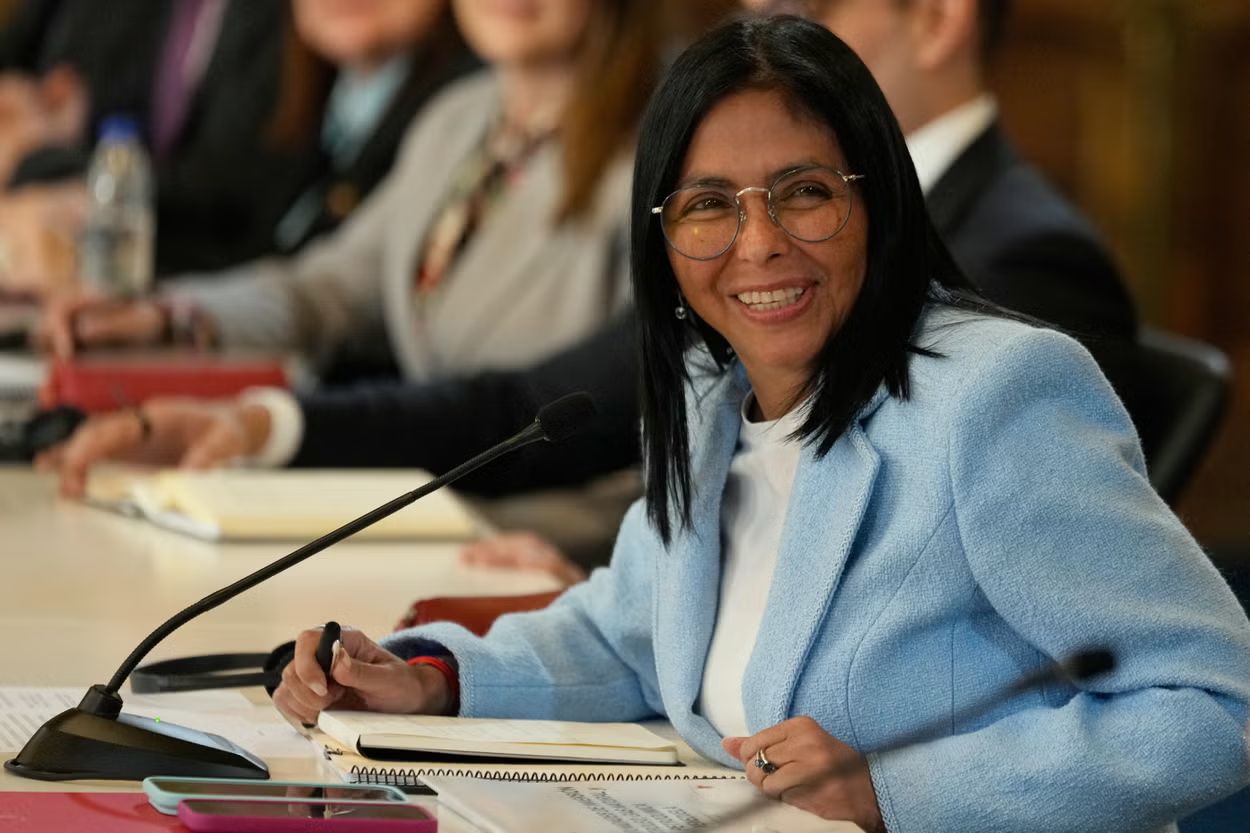
Venezuelan Acting President Delcy Rodríguez (AP)
By: Atlas
Delcy Rodríguez continued to serve as Venezuela's acting president on Monday, three days after the expiration of the 90-day window that the country's Supreme Court set for her temporary tenure following the U.S. capture of Nicolás Maduro in January.
The National Assembly, which is controlled by Rodríguez's ruling party and presided over by her brother Jorge Rodríguez, has not taken a public vote to extend her term. Nor has the legislature moved to declare the presidency permanently vacant — a step that would trigger a snap election within 30 days under the Venezuelan constitution. The government's press office did not respond to requests for comment on the status of her appointment.
Rodríguez assumed the acting presidency on January 3, hours after a U.S. military operation seized Maduro and his wife, Cilia Flores, in Caracas. The couple were transported to New York, where they face narco-terrorism charges. Both have pleaded not guilty. At their second hearing last week, a federal judge rejected a defense motion to dismiss the case after Maduro's lawyers argued he could not pay for legal representation because the U.S. Treasury Department had frozen his assets.
The Legal Framework Holding It Together
In the immediate aftermath of the January operation, Venezuela's Constitutional Chamber of the Supreme Court — long seen as loyal to the ruling party — issued what it called an "urgent and preventive" injunction. The three-page ruling classified Maduro's removal as a "forced absence," a designation that legal scholars have noted does not appear in the Venezuelan constitution.
The court's order stopped short of categorizing the vacancy as either temporary or permanent, a distinction that carries significant constitutional consequences. Under Venezuela's governing charter, a temporary absence can be filled by the vice president — Rodríguez's former role — for up to 90 days. The National Assembly can then extend that period for an additional 90 days, bringing the absolute maximum to 180 days. A permanent vacancy, by contrast, requires elections within 30 days.
Juan Carlos Apitz, dean of the Faculty of Legal Sciences at the Central University of Venezuela, has described the ruling as deliberately evasive. He argues that a permanent vacancy already exists in practical terms, since there is no reasonable expectation that Maduro will return to the country while facing criminal prosecution in the United States.
The Venezuelan human rights organization Provea warned over the weekend that the Supreme Court's silence on Rodríguez's continued tenure beyond the initial 90 days is not a neutral omission but a political decision. The group noted that if the second 90-day period is allowed to run its course, it would expire on July 5, at which point the National Assembly would be constitutionally obligated to declare a permanent vacancy and call elections.
Washington's Role
The Trump administration's approach to post-Maduro Venezuela has defied expectations. Rather than working with the country's political opposition — which Washington had backed for years, including through its recognition of opposition leader Juan Guaidó as interim president from 2019 to 2023 — the administration chose to engage directly with Rodríguez.
That engagement has accelerated in recent weeks. The U.S. State Department last month recognized Rodríguez as the "sole Head of State" of Venezuela in an ongoing federal civil case. The U.S. Treasury Department followed last week by lifting the sanctions that had been imposed on her since 2018 during Trump's first term, when she and her brother were designated for their alleged role in undermining Venezuelan democracy. The delisting allows Rodríguez to work more freely with American companies and investors.
In a statement posted to her Telegram channel, Rodríguez expressed hope that the sanctions relief would lead to broader normalization. The White House called the move a sign of "progress" in bilateral efforts to promote stability and economic recovery.
The administration also formally reopened the U.S. Embassy in Caracas on March 30, the first time it has operated since 2019. Secretary of State Marco Rubio credited the interim authorities with progress but called for an eventual democratic transition, telling Al Jazeera that Venezuela needs "a stable, democratic government" to fulfill its economic potential.
A Familiar Playbook
Ronal Rodríguez, a researcher at the Venezuela Observatory at Colombia's Universidad del Rosario, said the ruling party has a history of using creative legal interpretations to maintain its grip on power. He predicted the government would likely offer an explanation for the lapsed deadline — perhaps citing the Good Friday holiday or disputing how the days were counted — and that any resolution would ultimately be rubber-stamped by the Supreme Court.
Meanwhile, Rodríguez has moved to consolidate her position. She has reshuffled more than half of the cabinet she inherited from Maduro, replacing senior loyalists including his defense minister and attorney general. She approved an amnesty law and ordered the release of dozens of political prisoners, though the process remains incomplete. At a public event during Easter Week, she appeared alongside posters bearing the slogan "Delcy, move forward, you have my confidence" — displayed in blue and light tones rather than the red traditionally associated with the Chavismo movement.
The Treasury Department has also issued broad authorizations for Venezuela's state oil company, Petróleos de Venezuela S.A., to sell crude directly to U.S. companies and on global markets, reversing years of restrictions on the country's energy sector. The opening has drawn interest from international investors and oil companies, though analysts note that meaningful capital commitments will likely require greater political and legal certainty than the current arrangement provides.
Elections Nowhere in Sight
Despite street protests by opposition parties demanding a new National Electoral Council and fresh elections, neither U.S. nor Venezuelan officials have publicly addressed a timeline for a vote. The question of when — or whether — elections will be called remains the central unresolved issue in a country whose institutional framework now rests on a three-page court ruling, the acquiescence of a party-controlled legislature, and the implicit backing of Washington.
Apitz, the legal scholar, put it bluntly: elections will happen when the United States decides they should. He noted that oil and mining companies are pushing for political certainty before making the large-scale investments Venezuela needs, and that those companies see a volatile social situation that could deteriorate without a democratic resolution. The constitutional clock, as Provea noted, is ticking — even if no one in power appears to be watching it.

Subscribe to the BLUF to read the rest.
Delivered Tuesday, get insights into the most pressing geopolitical issues from an intelligence perspective. Stay ahead of the curve with a comprehensive look at the top stories around the world and their implications for you.
Already a paying subscriber? Sign In.
A subscription gets you:
- • Lifetime Rizz
Reply