- The BLUF
- Posts
- The BLUF - December 9th
The BLUF - December 9th

Atlas News
December 09, 2025
Good morning everyone,
This is Atlas, and you’re reading the Bottom Line Up Front, where we cover the top geopolitical stories from around the world every Tuesday!
Today’s topics:
Thailand-Cambodia Peace Deal Threatened Amidst Renewed Border Attacks
China Tops $1 Trillion In Trade Surplus For First Time
EU Tightens Migrant Return Policy, Plan For ‘Return Hubs’
Thailand-Cambodia Peace Deal Threatened Amidst Renewed Border Attacks
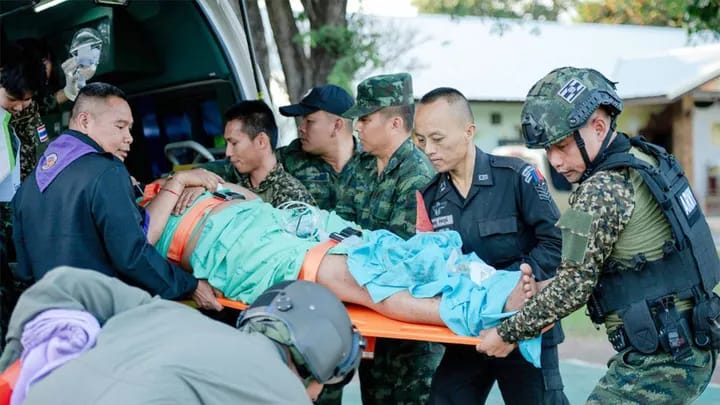
A wounded Thai soldier is carried to be transferred to a hospital in Sisaket province, Thailand, Sunday, Dec. 7, 2025 (Royal Thai Army)
By: Atlas
Thailand sent F-16 fighter jets to bomb Cambodian military positions Monday morning after overnight clashes along the disputed border between the two countries. The attacks mark the collapse of a peace deal that President Donald Trump signed with both nations just six weeks ago.
One Thai soldier was killed. Four Cambodian civilians died. Hundreds of thousands of people on both sides packed belongings onto motorcycles, tractors and trucks and fled their homes.
"No more negotiations," Thai Prime Minister Anutin Charnvirakul said in a televised address. "Thailand has never initiated a fight or an invasion, but will never tolerate a violation of its sovereignty."
Cambodian Prime Minister Hun Manet responded on Facebook, urging citizens and armed forces to "unite for the cause of the nation and the homeland during this difficult period."
Both governments say the other side shot first.
Sunday's firefight set off the escalation
The trouble started Sunday evening in Thailand's Sisaket province. Thai and Cambodian troops exchanged rifle fire for about 20 minutes. Two Thai soldiers were wounded.
Thailand said Cambodia opened fire. Cambodia said Thailand did.
By 5 a.m. Monday, the situation had deteriorated badly. Fighting broke out in five locations along the frontier. Thai army spokesman Maj. Gen. Winthai Suvaree said Cambodian artillery struck near residential areas in Thai territory. He said Thailand called in air support to hit Cambodian military targets.
The Royal Thai Air Force said it deployed F-16s against three Cambodian artillery positions. Targets included a casino that Thai officials alleged Cambodia was using to launch bomb-carrying drones into Thailand's Ubon Ratchathani province.
"The ultimate goal is to destroy as many of Cambodia's supporting fire systems as possible," Suvaree said.
Cambodia's Defense Ministry spokeswoman Maly Socheata gave a different account. She said Thailand attacked first and Cambodian forces did not retaliate.
Hun Sen, Cambodia's influential former prime minister and father of the current leader, called Thai forces "aggressors" and urged his country's troops to show restraint. He warned that a "red line for responding has already been set" but did not elaborate.
Trump's peace deal is in tatters
Trump presided over the signing of a formal ceasefire agreement on October 26 in Kuala Lumpur, Malaysia. He had pushed both countries to stop fighting after a five-day conflict in July killed at least 48 people and displaced some 300,000.
"We did something that a lot of people said couldn't be done," Trump said at the signing ceremony.
The deal never addressed the core problem: where the border actually runs. Thailand and Cambodia have fought over that question for more than a century. A 1907 map drawn by French colonial authorities forms the basis of modern claims, but Thailand has long argued the map is wrong. The International Court of Justice awarded Cambodia sovereignty over an area including the ancient Preah Vihear temple in 1962. Many Thais still resent that decision.
The October agreement was already wobbling before this week. In early November, four Thai soldiers stepped on land mines while patrolling the border zone. Thailand blamed Cambodia for planting fresh mines and suspended implementation of the peace deal. Cambodia denied responsibility.
Trump said in mid-November he had personally intervened to keep the ceasefire from falling apart.
It fell apart anyway.
Malaysian Prime Minister Anwar Ibrahim, who helped broker the original deal, appealed for calm Monday.
"The renewed fighting risks unraveling the careful work that has gone into stabilizing relations between the two neighbors," Anwar said. "Our region cannot afford to see long-standing disputes slip into cycles of confrontation."
Civilians caught in the crossfire
The human cost mounted quickly. Thailand's Defense Ministry said more than 35,000 people had reached temporary shelters by Monday afternoon. Officials said they were evacuating over 385,000 civilians from four border districts.
Across the frontier, Cambodian authorities moved more than 1,100 families out of Oddar Meanchey province. Cambodia's information minister, Neth Pheaktra, said Thai fire killed four Cambodian civilians and wounded nine others.
Phichet Pholkoet, a resident of Thailand's Ban Kruat district near the border, told Reuters he heard gunfire starting early Monday morning.
"It startled me. The explosions were very clear. Boom boom!" he said by telephone. "Some are heavy artillery, some are small arms."
Nearly 650 schools in five Thai provinces shut down for safety. Villagers who stayed behind dug makeshift bunkers and cooked over open fires. Thai armored personnel carriers rolled toward coils of barbed wire along the border in Sakeo province.
Late Monday afternoon, Thailand's Second Army Region issued a public warning: Cambodia was expected to attack again overnight using BM-21 multiple rocket launchers capable of hitting targets 30 kilometers inside Thai territory.
Thailand holds the military edge
The two countries are not evenly matched. Thailand spent $5.73 billion on defense in 2024 and fields more than 360,000 active troops. Its air force operates 28 F-16s and 11 Swedish Gripen jets.
Cambodia's defense budget was $1.3 billion. Its air force has no fighter aircraft—just 16 helicopters.
Thailand is a major non-NATO ally of the United States. Cambodia is one of China's closest partners in Southeast Asia.
That imbalance shapes the conflict. Thailand can strike from the air. Cambodia cannot. But Phnom Penh has options on the ground, including the rocket launchers Thailand warned about Monday evening.
The last major armed clash between the neighbors occurred in 2011, when artillery exchanges lasted a week. Cross-border airstrikes of the kind Thailand launched Monday are rare anywhere in Southeast Asia.
Amnesty International's regional research director, Montse Ferrer, called on both governments to protect civilians.
"The resumption of hostilities around the Thailand/Cambodia border risks civilian lives, mass displacement and the destruction of essential civilian infrastructure," Ferrer said.
Neither side showed signs of backing down as of Monday night.

Subscribe to the BLUF to read the rest.
Delivered Tuesday, get insights into the most pressing geopolitical issues from an intelligence perspective. Stay ahead of the curve with a comprehensive look at the top stories around the world and their implications for you.
Already a paying subscriber? Sign In.
A subscription gets you:
- • Lifetime Rizz
Reply